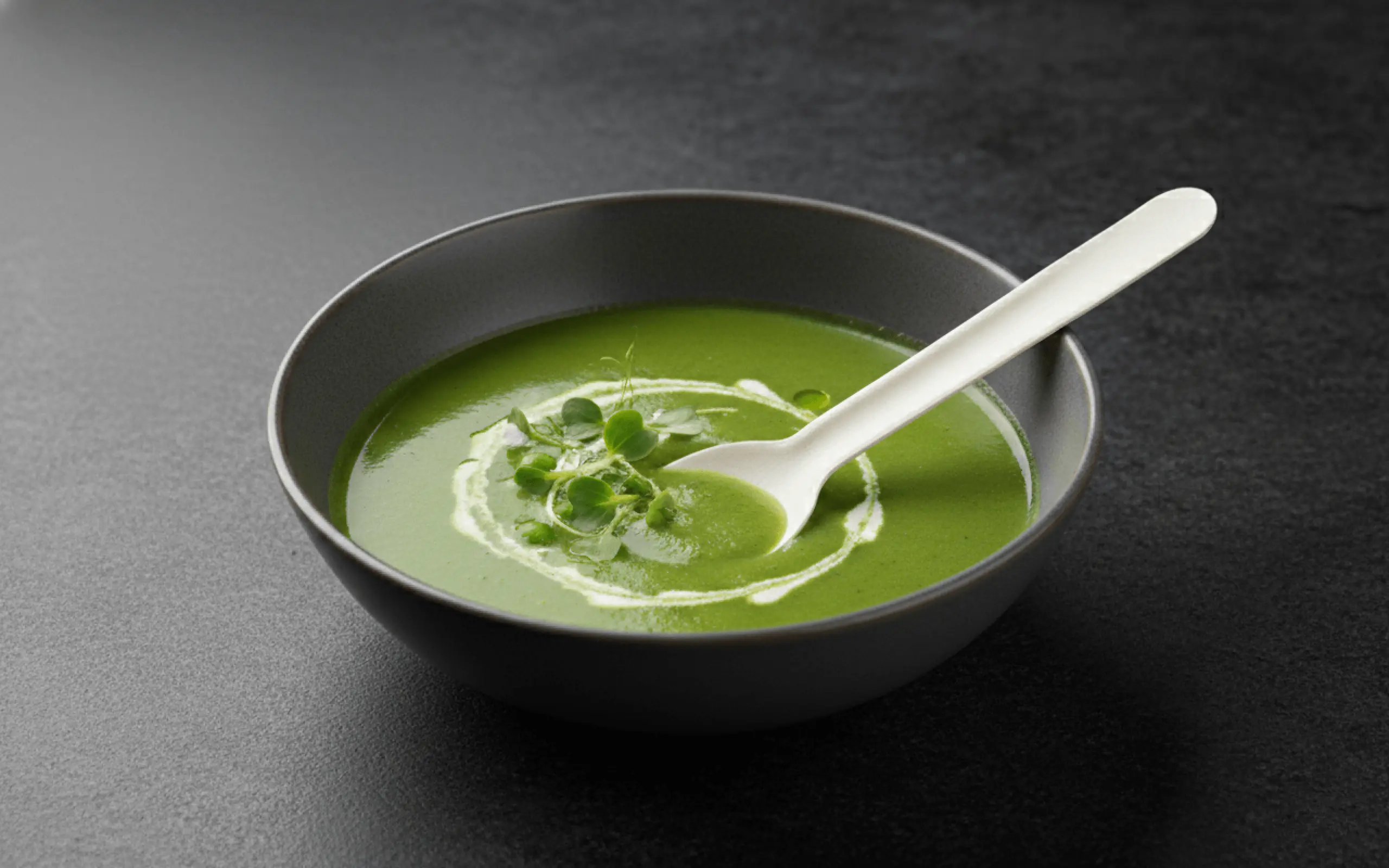
The “Melting Spoon” Myth
There is a persistent myth in the food industry: “Paper cutlery is great for cake, but terrible for soup.”
For years, this was true. Early generations of paper spoons were essentially shaped cardboard. They would dissolve in hot liquids within minutes, leaving customers frustrated and messy. This led many restaurants to stick with plastic (bad for the planet) or wood (bad for the taste).
But manufacturing technology has evolved. At Epherware, we don’t ask you to take our word for it. We believe in data.
In our manufacturing facility in Gujarat, we subjected our Classic Paper Spoon (3.2g) to a rigorous thermal stress test to see if it could handle the heat of a commercial kitchen. Here is exactly how our 9-layer paper performs under pressure.
The Methodology: 100°C vs. Paper
To validate our engineering, we simulated a typical “slow dining” scenario. Imagine a customer orders a piping hot Manchow soup or a scalding hot coffee and takes their time consuming it while chatting or working.
- Test Subject: Epherware Classic Paper Spoon.
- Material: 9-Layer Virgin Food-Grade Paper (1025 GSM).
- Medium: Hot Vegetable Broth.
- Temperature: Maintained at 90°C – 100°C (Near boiling point).
- Duration: 45 Minutes (Twice the average dining time).
Result 1: Structural Rigidity (The Bend Test)
The most common failure point for disposable cutlery is the “neck”—the narrow point where the handle meets the bowl of the spoon.
How Standard Spoons Fail: Most generic spoons use low-density paper (approx 600 GSM). As moisture seeps into the air gaps between layers, the neck softens. When the user lifts a spoon full of liquid, the weight causes the neck to buckle or bend backward.
The Epherware Result: After 45 minutes of submersion, we performed a lift test with heavy vegetables. The Epherware spoon retained its stiffness. There was no warping at the neck.
Result 2: Mouthfeel & Texture (The “Furring” Test)
If you have ever used a cheap paper straw, you know the feeling of “furring.” This happens when the outer layer of paper begins to peel, dissolve, or roughen, creating an unpleasant, fuzzy texture on the lips.
The Epherware Result: Our surface remained smooth and polished. Because we use a proprietary water-based bonding process and high-pressure glazing, the outer layer does not delaminate. The spoon felt indistinguishable from the moment it was dipped in.
Result 3: Chemical Leaching (The Taste Test)
Heat accelerates chemical reactions. This is why plastic spoons often release BPA when heated, and wooden spoons release resins that make the soup taste “woody” or “oily.”
The Physics: Why It Survived
Why did our spoon survive when others fail? It comes down to Density.
Imagine a sponge vs. a brick. A sponge (low density) absorbs water immediately. A brick (high density) repels it. Standard paper spoons are like the sponge—full of air gaps. Epherware spoons, compressed to 1025 GSM, are like the brick. By eliminating microscopic air gaps between the 9 layers, we remove the space where water molecules usually hide.
Conclusion: Ready for the Kitchen
The days of apologizing for eco-friendly cutlery are over. You no longer have to choose between “Sustainable” and “Functional.”
If your current cutlery cannot survive a bowl of hot soup, it isn’t a solution—it’s a liability. Epherware is engineered for the reality of hot, messy, delicious food.
Leave a Reply